


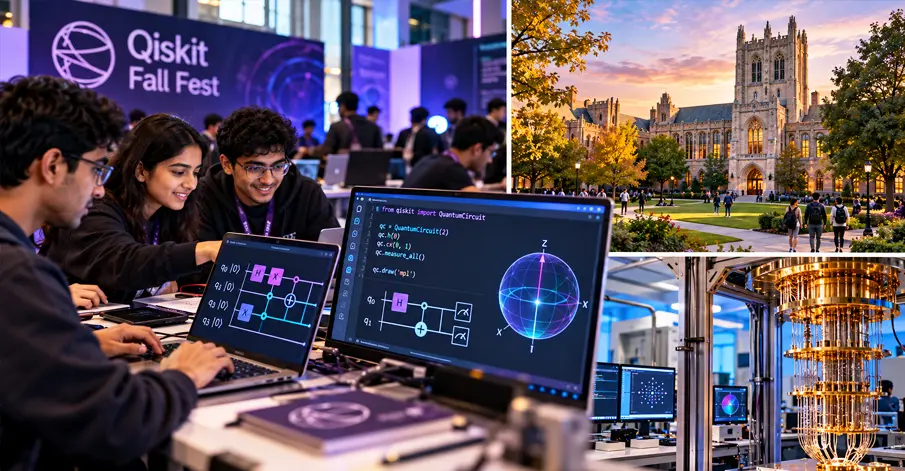
Maharashtra Higher and Technical Education Minister Chandrakant Patil has called for state institutions to expand quantum-technology research, expose more students to the field and convert technical advances into patents and intellectual-property revenue. He made the remarks while inaugurating the three-day Qiskit Fall Fest 2026 at Dr Babasaheb Ambedkar Technological University in Lonere, Raigad.
The programme brings students, researchers and technology specialists together around quantum computing and associated software tools. Patil linked research output with long-term technology and economic capacity, arguing that universities must develop patentable technologies rather than limiting their activity to teaching and theoretical work.
Representatives participating in the event also highlighted the growing importance of post-quantum cryptography. Current public-key encryption systems could eventually become vulnerable to sufficiently capable quantum computers, creating a requirement for enterprises, financial institutions, governments and infrastructure operators to identify affected systems and prepare migration plans before such machines are commercially available.
India’s National Quantum Mission has an approved expenditure of ₹6,003.65 crore for the period through 2030-31. The mission covers quantum computing, secure communications, sensing, metrology, materials and devices. Its computing objectives include developing intermediate-scale systems across technologies such as superconducting and photonic platforms.
Maharashtra already has a substantial concentration of universities, financial institutions, data centres, technology companies and industrial research organisations. Expanding quantum education and patent creation would require coordination between these institutions, government laboratories, startups and companies that can commercialise research.
The policy challenge extends beyond building a quantum processor. Domestic capability also depends on specialised electronics, cryogenic equipment, photonics, control systems, algorithms, fabrication, standards and cybersecurity migration. Post-quantum security work can begin before large-scale quantum computers arrive because cryptographic inventories and system replacements often take several years.
Patil’s comments place student training and university research within this wider national programme. The immediate event is education-focused, but the stated objective is to create a pipeline connecting exposure, applied research, patents and commercial technology development.